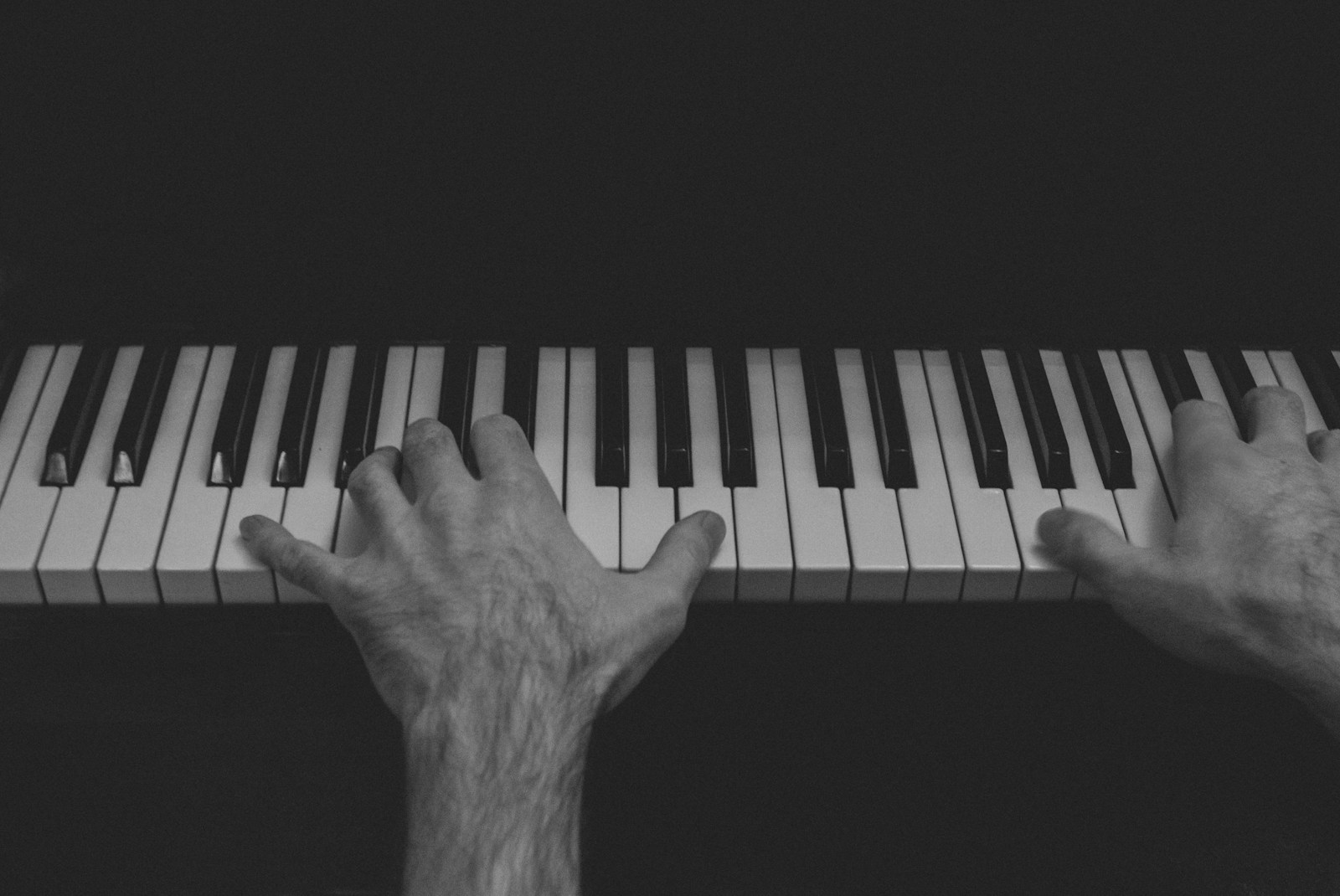
“It is never too late to start, but it is much easier if you don’t wait.” The line came from a Conservatory of Milan professor I interviewed last year, and she meant it with the affection of someone who has spent thirty years taking adults seriously. The notion that piano is a children’s art has survived into 2026 despite overwhelming evidence against it. Adult beginners outnumber child beginners in Italian private music schools and have for a decade. The question is not whether an adult can learn, but how to do it without the mistakes that cause most adults to quit inside eighteen months.
Why adults are better students than they think
The neurological argument against late starters is real but narrow. A six-year-old develops finer motor coordination faster than a forty-year-old. That is the ceiling. Everything else — reading, harmonic understanding, memory strategy, musical taste, patience with detail, ability to practise without supervision — favours the adult. In practical terms, a committed adult beginner with an hour a day will outpace a resistant nine-year-old with thirty minutes, and within two years will be playing material the child has not yet met.
What adults struggle with is not capacity. It is the psychological habit of being bad at something in public after years of professional competence at other things. Every adult piano student I know has described, in some form, the specific mortification of playing a Czerny exercise badly in front of a teacher. This is not a small thing. Managing it is arguably the real skill of being an adult beginner.
Instrument choice, because this decides everything else
You cannot practise seriously on a toy keyboard. Sixty-one keys, unweighted, no pedal — these are instruments for children at the introductory phase, and an adult will outgrow them inside two months. Eighty-eight fully weighted keys with a damper pedal is the minimum specification, and it is not negotiable.
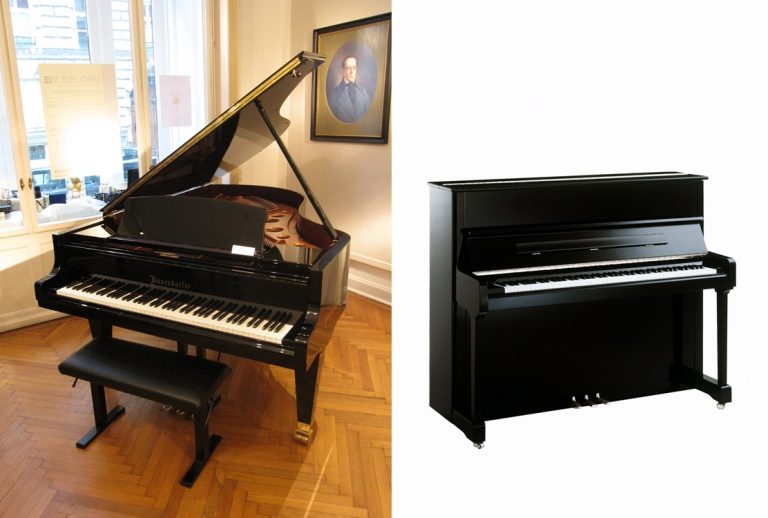
Within that, you have three options. An acoustic upright, used, in the 1,500 to 3,500 euro range, is the traditional answer and still the best for feel and tone. The downside is tuning (once or twice a year, around 80 euros each time), space, and the fact that you cannot play it at midnight without annoying neighbours. A digital piano with weighted hammer action — a Kawai ES120, Yamaha P-225, or Roland FP-30X in the 600 to 900 euro range — solves the acoustic problems and plays credibly enough for the first two or three years. A hybrid like the Kawai Novus NV5S is in a separate price bracket (4,000+ euros) and is overkill for a beginner.
The decision hinges on one question: where will you practise? If the answer is “a home I own, with neighbours I can occasionally bother”, buy the upright. If the answer is “an apartment, with headphones, at night”, buy the digital. The wrong choice here is the most common reason adults abandon the instrument in year one.
Teachers versus apps
The honest answer in 2026 is that you need both, in different proportions at different stages.
A human teacher, once a week, for at least the first year, is not optional. The reasons are not primarily pedagogical. They are about hand position, weight transfer, fingering choices, and the dozens of small physical habits that an app cannot see and cannot correct. Bad technique ingrained in year one takes three years to undo; good technique taught in the first six lessons lasts a lifetime. Budget 40 to 70 euros per hour for a conservatory-trained teacher in a major Italian city; slightly less in smaller towns.
Apps — Simply Piano, Flowkey, Playground Sessions, the newer AI-feedback tools like Piano Marvel — are useful between lessons for sight-reading drill and for learning repertoire your teacher has approved. They are terrible as your only input because they cannot diagnose a collapsed wrist or a thumb that is tucking under too slowly. Use them for about twenty minutes of a sixty-minute practice session, not as the main course.
Group lessons at a music school are a middle option that works surprisingly well for adults who fear the intensity of one-on-one teaching. The social component gets you through the awkward phase faster. You will progress more slowly, but you will not quit.
The first six months: what actually happens
Month one is mostly about sitting properly, finding middle C, and playing five-finger patterns with both hands separately. You will learn three or four simple pieces — almost certainly something from the Alfred, Faber, or Beyer method books your teacher selects. Nothing will sound good yet, and this is a critical test. Adults who expect to play Clair de Lune in week six quit in week ten. Adults who expect to learn “Ode to Joy” in week six in both hands, slowly, and badly, survive.
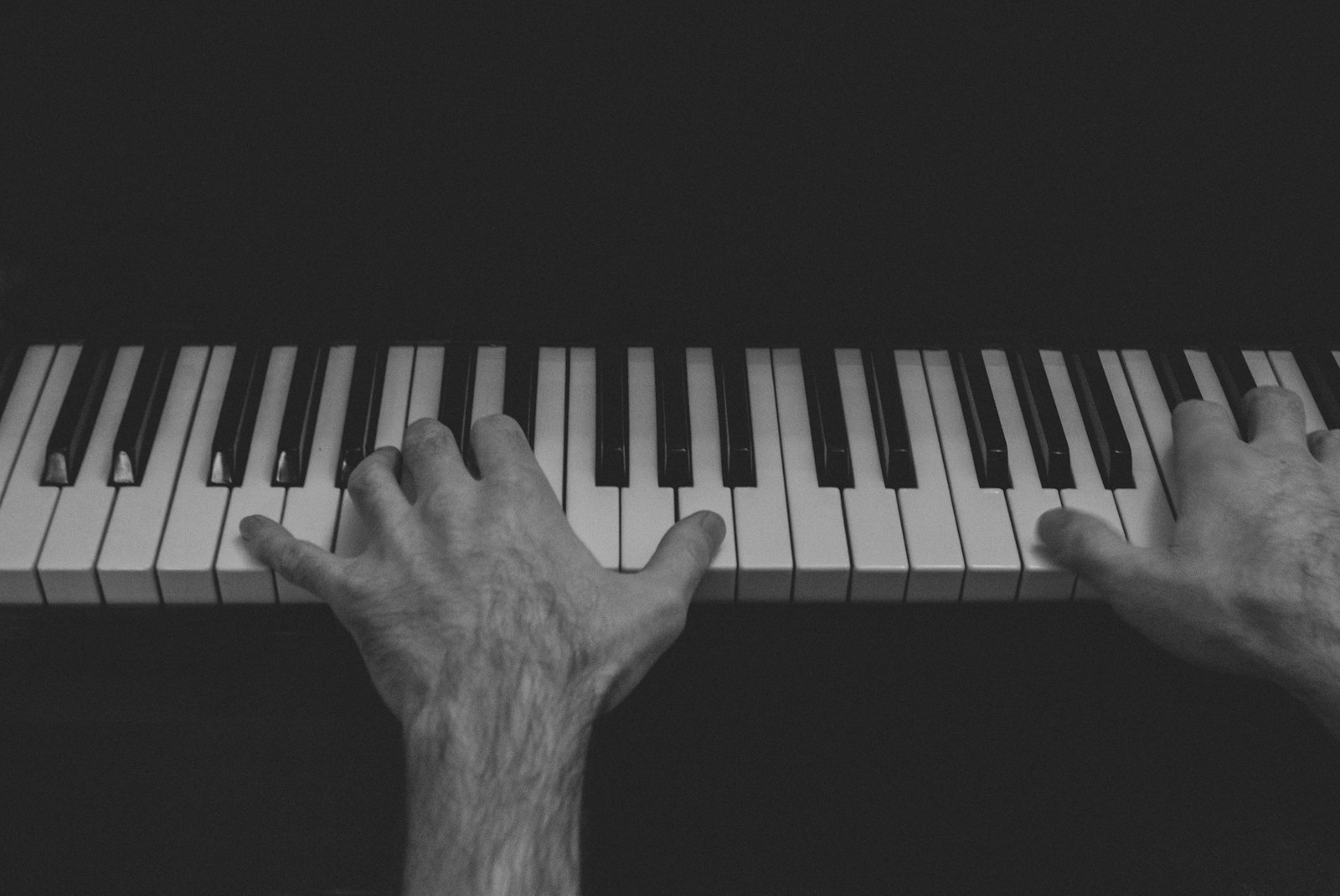
Month two introduces hands-together playing, which is genuinely hard and feels disproportionate to how simple the music looks. This is when most adults hit the first wall. Your brain is attempting to run two independent motor programmes in parallel, and it protests. Practising each hand separately ten times before trying them together is not a failure of ambition; it is the technique.
By month four you can play simple pieces in both hands, read music in treble and bass clefs at a slow tempo, and handle basic pedalling. You will also discover that your left hand is noticeably worse than your right, which is normal and takes two years to equalise.
By month six an adult who practises consistently can play a simplified Bach minuet, something from Schumann’s Album for the Young, and the opening of a recognisable pop song. This is the graduation moment from absolute beginner to early intermediate. Roughly half of adult starters reach it; the other half have either quit or slowed to a practice cadence that will not sustain progress.
How much practice, realistically
The research on deliberate practice applies to adults and children equally: forty-five minutes a day, five days a week, with focused attention, outperforms two hours a day, seven days a week, with distracted attention. The quality of practice matters more than the quantity.
That said, below twenty minutes a day, four days a week, no progress is visible. This is the floor. Adults who tell themselves they will “find time when they can” without scheduling are describing the experience of most adult beginners who quit. Fix a time — 7 am before the day starts, 9 pm after dinner, Sunday mornings for a longer session — and treat it as a commitment rather than a preference.
Structure the forty-five minutes roughly as follows. Five minutes of scales or warm-up exercises. Fifteen minutes on a technique item your teacher assigned. Fifteen minutes on the repertoire piece you are currently learning, practising the hardest four bars fifteen times and only then playing it through. Ten minutes on sight-reading something new and easy. This is not the only valid structure, but a version of it is what conservatory students do, and it is what makes progress non-linear rather than frustratingly flat.
Repertoire, or what you will actually play
Adult beginners tend to arrive with a list of dream pieces: Chopin nocturnes, the Moonlight Sonata, Gymnopédies, maybe Clair de Lune or Ludovico Einaudi. Your first year will not include these, and you need to make peace with that.
What you will play in year one is a mixture of Anna Magdalena Bach notebook minuets, simplified Schumann, early Clementi sonatinas, the easier Burgmüller etudes, and whichever folk-song arrangements your method book provides. It is possible to supplement this with simplified arrangements of music you love, and a good teacher will. But the core diet of early piano is Baroque and Classical, because that is where the technique lives.
Year two opens up the standard intermediate repertoire: the first Schumann pieces that require real pedalling, Clementi or Kuhlau sonatinas complete, the easier Bach two-part inventions, and, toward the end of the year, your first attempt at a piece from the popular recital canon. Erik Satie’s Gymnopédie No. 1, the Einaudi piece most players want, and simplified Debussy all sit at the upper edge of year-two repertoire.
Year three is where the instrument begins to reward you. A patient adult beginner can, at that point, play intermediate Chopin preludes, Bach inventions complete, Mozart sonatas in the easier keys, and reasonable jazz standards with lead-sheet harmony. This is the point where the initial bargain the adult made — years of frustration in exchange for a lifetime of playing — starts to pay.
The first recital
Roughly eighteen months in, most students face their first recital. In Italian private music schools this is usually a low-key end-of-year gathering in the school’s main room, with families and other students as the audience. The pieces are prepared; the room is friendly; the stakes are, objectively, low.
Subjectively, they are enormous. Your pulse climbs. Your hands shake slightly. You sit at an instrument you have never played before, in a room whose acoustics are different from your practice space, in front of an audience that includes one or two people whose approval matters to you. You play the piece you have rehearsed a hundred times, and something in the middle goes slightly wrong — a missed note, a rhythmic stumble, a fingering you change on the fly — and you recover, or you don’t. Then it is over.
Two things matter about this experience. First, the anxiety is not a sign you are not ready. It is the nervous system responding appropriately to a high-cost social situation. Every professional pianist I have interviewed still feels it, forty years in. Second, the memory of the first recital, for almost every adult who survives it, becomes a source of pride rather than embarrassment within a year. Even the ones who stumbled. Especially them.
Reader questions, answered in order
Am I too old? No. The oldest beginner I have met was seventy-three; she had been told her whole life she was not musical. Within three years she was playing the easier Bach preludes, from memory, in a recital at her church. If your hands are not arthritic to the point of pain and you can see sheet music clearly, you are physically capable.
What if I cannot read music? You will learn. Music literacy for an adult with reasonable reading skills in any language takes about six months to become functional and two years to become fluent. It is not the hardest part.
Is perfect pitch required? No, and barely any professional pianists have it. Relative pitch — hearing the distance between notes — is the useful skill, and it is trainable at any age. A focused ear training programme in parallel with your first year of piano lessons is the single highest-leverage supplement you can add.
My child is also taking lessons. Will I be humiliated if she passes me? Possibly. Children accelerate through the early middle stages faster than adults do. Use it as motivation. Most adult beginners who continue past year three catch up with and pass the teenage versions of themselves that started at twelve.
I bought a cheap keyboard. Should I upgrade? If it has fewer than 88 weighted keys and a pedal input, yes, before the end of month three. This is the single biggest predictor of whether an adult student continues past six months. Spending 700 euros on the right first digital saves you the 1,400 you would have spent total on two wrong ones.
The year-three question
By year three, the adult piano student who is still practising has become, quietly and without fanfare, a musician. The distinction between “someone who takes piano lessons” and “someone who plays the piano” blurs somewhere around the twenty-fourth or twenty-eighth month. You begin to think in keys. You hear a song in a café and your fingers work out its chord progression under the table. You sit down at a friend’s piano at a dinner party and play, briefly, not because you were asked but because the instrument was there and you could.
At that point most adult learners face a genuine decision: keep the weekly teacher and continue through the conservatory-style intermediate curriculum, or transition to a less formal relationship — a coaching session every three or four weeks, with self-directed repertoire between. Both work. The choice depends more on personality than on skill.
If you want to record the pieces you are learning — which is genuinely useful for hearing yourself as an audience hears you — a modest home studio under 500 euros can produce recordings of surprising quality with a single stereo pair of small-diaphragm condenser microphones over the instrument.
The professor I quoted at the opening of this piece said something else I have remembered: “The question is not whether you will be a great pianist. The question is whether, thirty years from now, you will have spent thirty years playing the piano.” Put that way, the calculation changes. Begin now. The worst day to plant a tree was twenty years ago. The second-worst day is tomorrow.
References
- BBC Culture reporting on adult music learners
- New York Times — Music section
- The Guardian archives on piano pedagogy
Sull'Autore