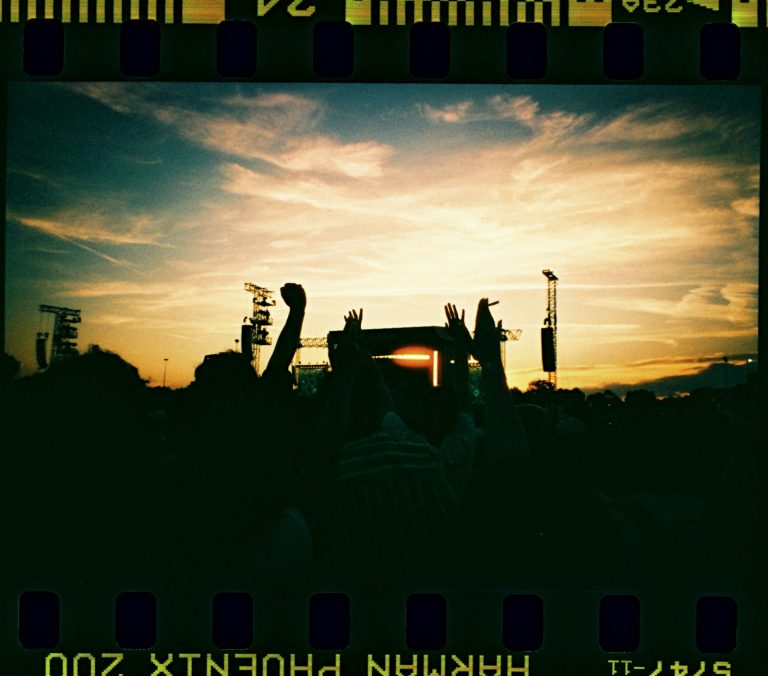
The first photo pit I worked, at a small jazz festival in Umbria in 2011, contained eight photographers crowded into perhaps three metres of space directly in front of the stage. The unspoken etiquette was learned within minutes. You did not block the view of the photographer to your left. You changed lenses quickly so the others could move. You exited after the agreed three songs without being asked. Anyone who broke these rules was simply never accredited again at any festival in the region. The pit, in other words, was a small society with strict customs and effective enforcement. Festival photography ethics begin there but extend much further.
This piece looks at what serious festival photography practice actually involves in 2026: the photo-pit conventions, the rights and consent issues that have evolved since the rise of social media, the contractual landscape that regulates what photographers can do with their images, and the deeper craft questions about what makes a music photograph worth making.
The standard photo-pit conventions
Most major European and North American festivals operate on what the industry calls the “first three songs, no flash” rule. Accredited photographers may shoot during the first three songs of an artist’s set, without flash, from a designated photo pit in front of the stage. After the third song, photographers exit. This rule originated in the late 1970s in part because some artists wanted to control how images of later, more emotionally exposed parts of their sets circulated.
The first-three-songs rule is not universal. Smaller festivals often allow shooting throughout. Some major artists impose stricter limits — Beyoncé, Prince during his lifetime, and Adele have at various times required photo waivers limiting use to specific publications. Many electronic and DJ-led acts limit photo coverage to the first thirty minutes rather than three songs, since DJ sets do not have clear song boundaries.
The “no flash” rule is essentially universal. Beyond the obvious courtesy reasons, flash interferes with stage lighting design and is a safety issue for performers who depend on visual cues. A photographer caught using flash at almost any major festival will have credentials revoked.
Contracts and image-use restrictions
Most festival accreditations now require the photographer to sign a use agreement before being granted credentials. The terms vary widely. The most permissive agreements grant the photographer broad commercial rights to the resulting images. The most restrictive limit use to a single editorial publication, prohibit personal portfolio use, and assign substantial rights to the festival or artist.
The trend over the past decade has been toward more restrictive contracts. Several artists, working through management, now require what photographers refer to as “rights grab” agreements — contracts that assign image rights to the artist’s management for unspecified future use. The National Press Photographers Association and the Pictures Guild in the UK have campaigned against the most aggressive versions of these contracts. Some publications, including The Guardian and Rolling Stone, have at various times refused to cover artists who require such contracts.
For working photographers, the practical consequence is that contracts must be read carefully before shooting. Once an image has been made under a restrictive contract, the photographer’s later options are limited.
The audience-image question
Photographing the audience is one of the more contested ethical territories of festival photography. Crowd shots, particularly close-up portraits of audience members, raise consent and privacy issues that are increasingly significant under European data protection law (GDPR) and similar frameworks elsewhere.
The practical position adopted by most professional festival photographers in 2026 is to seek consent for identifiable portraits of audience members, particularly minors, and to use wider crowd shots in which individuals are not centred or recognisable when consent cannot be sought. Several major festivals now post notices that photography is in progress, which provides a measure of legal cover under the consent-by-attendance argument, but this varies by jurisdiction.
The more difficult question is what to do with images of audience members in distress, intoxicated, or otherwise in compromised states. The most ethical practice, articulated through industry-published guidelines including the Music Photographers’ Charter circulated within the European music journalism community, is not to publish such images even if they are technically the photographer’s property. The harm to the individuals usually exceeds any journalistic value of the image.
What separates good festival photography from cataloguing
The technical floor for festival photography has dropped substantially with modern camera technology. A modern mirrorless camera with a 70-200mm zoom and reasonable low-light performance produces technically acceptable concert images in the hands of almost any competent photographer. The differentiator is no longer technical capability but visual judgment.
The festival images that hold up — that get published years later in retrospectives and obituaries and biographies — usually share certain features. They show the artist in a moment of unguarded performance rather than a stage-managed pose. They use the available stage lighting expressively rather than fighting it. They include enough environmental context that the image is not merely a portrait but a record of a specific performance. And they frequently use depth of field, framing or motion blur in ways that go beyond the standard documentary record.
The work of photographers like Henry Diltz, Annie Leibovitz in her early Rolling Stone years, Roberta Bayley, Barron Claiborne and the contemporary work of Danny Clinch and Mick Rock established the visual language that the field now operates within. Studying their work — books like Diltz’s Under the Covers or Leibovitz’s At Work — gives a working photographer a much stronger eye than any technical tutorial.

Working with managers and publicists
Most accreditation decisions are made by tour publicists or festival press teams rather than by artists directly. The photographer’s relationship with these gatekeepers determines long-term access far more than any individual image. Several practical conventions apply:
- Always credit the artist correctly and credit the venue or festival on initial publication.
- Send a small selection of finished images to the artist’s management within a reasonable window after the show, even when not contractually required.
- Do not negotiate publicly on social media when access decisions are made; almost any complaint reaches the relevant publicist within hours.
- Build relationships across multiple tours rather than treating each accreditation as a one-off transaction.
Working photographers report that durable careers in music photography are built primarily on these relationships, not on any individual image. The publicists and managers who grant access are themselves under pressure to deliver good coverage to their artists, and a photographer who consistently produces images that the artist’s team is happy to circulate becomes a valuable commodity.
The economic reality
Music photography in 2026 is a difficult living. The collapse of music magazine economics over the past two decades has meaningfully reduced editorial assignment fees. Most working music photographers combine concert work with commercial assignment, portrait work, music video stills and other parallel income streams. Pure festival photography as a primary career exists but is rare.
The economic squeeze has produced second-order effects. Festivals increasingly invite photographers to shoot for free in exchange for accreditation and image-use rights, which has driven down rates for paid work. Several professional bodies, including the Press Photographers’ Association in the UK and the National Press Photographers Association in the US, have campaigned against unpaid editorial concert photography on grounds that it undermines the labour market.
What the festival image is actually for
The deeper question — what is festival photography ultimately for — is worth pausing on. The photographs are made simultaneously as historical record, as marketing material, as journalistic illustration and as personal artistic statement. These purposes pull in different directions. A photograph that serves the artist’s marketing well may sanitise the performance; a photograph that records the performance honestly may not serve the marketing at all.
The most respected music photographers tend to make work that serves the journalistic and historical functions first, with the marketing function emerging as a side effect. The 2024 Pat Pope retrospective at the Photographers’ Gallery in London traced this through three decades of British music photography and made the case that the durably significant images are usually the ones the photographer thought were honest rather than flattering.
Equipment and technical considerations
The technical requirements for festival photography have evolved substantially over the past decade. The current professional standard is a full-frame mirrorless camera body — Sony A1, Sony A9 III, Canon R3, Nikon Z9 — paired with one or two telephoto zoom lenses. The 70-200mm f/2.8 zoom remains the workhorse for medium-distance pit shooting. A 24-70mm f/2.8 covers wider stage shots and crowd context. For larger venues, a 100-400mm or 200-600mm zoom becomes useful, particularly when the photo pit is set substantially back from the stage as it is at festivals like Glastonbury and Coachella.
Beyond the camera and lenses, the most-overlooked equipment element is the rain cover. Major outdoor festivals routinely operate through rain, and many press contracts require the photographer to continue shooting regardless of conditions. Quality rain covers from Think Tank, Aquatech and OP/TECH are essential and frequently neglected by inexperienced festival photographers. Earplugs are similarly essential — the front-of-stage sound pressure at major festivals routinely exceeds 110 decibels, and chronic hearing damage is a documented occupational injury for working concert photographers.
For storage and backup, the standard professional practice is dual-card recording (most modern bodies support simultaneous CFexpress and SD writing), an evening backup to portable SSD, and cloud backup of selected images before leaving the festival site. Festival logistics frequently produce situations in which equipment is lost, stolen or damaged, and a backup discipline that keeps copies in three separate physical locations is the minimum reasonable practice.
Comparative analysis: how festival photography differs from venue concert work
Festival photography and venue concert photography are often discussed together but require different skills and conventions. Venue work — clubs, theatres, concert halls — typically allows longer access (full sets in many cases), works with consistent lighting from one show to the next, and develops over a relationship between the photographer and a small number of venues over multiple years. Festival work compresses the same demands into 15 to 90 minutes per artist, across 15 to 30 artists per day, with constantly changing lighting designs and stage configurations.
The difference shapes the visual language of the resulting images. Venue photographers like Mick Rock in his Bowery Ballroom work, or the contemporary club photographer Marc Johnson in his ongoing Brooklyn series, produce images with substantial intimacy and atmospheric specificity. Festival photographers like Danny Clinch in his long-running Bonnaroo work, or Renaud Monfourny in his French festival coverage, produce images with stronger graphic clarity but less per-image intimacy. Both modes are legitimate; they answer different questions about what a music image should do.
Misconceptions worth correcting
Several misconceptions about festival photography circulate among aspiring photographers. The first is that better gear primarily determines image quality. It does not, beyond a relatively modest baseline. The 2014 photographer-skill comparison study run by the photography forum Fred Miranda asked working photographers to identify the more expensive of two cameras based on resulting images and found accuracy at chance level for cameras above the entry-pro tier. What separates professional festival photographers from amateurs is mostly preparation, anticipation and timing, not equipment.
The second misconception is that festival accreditation is primarily about the photographer’s portfolio quality. It is more often about the publication the photographer represents and the publicist’s prior experience with the photographer. A weaker portfolio with a strong publication assignment frequently produces accreditation that a stronger portfolio with no assignment cannot. Building relationships with editors at music magazines and online music publications is therefore as important as building the portfolio itself.
The third misconception is that the standard “first three songs, no flash” rule is universally enforced. It is not. Smaller festivals frequently allow longer access. Some headlining artists waive the restriction for trusted photographers. Artist preferences override festival defaults. The practical advice is to read the per-artist accreditation rules carefully before each set rather than assuming the standard rule applies.
Implementation: building a festival photography portfolio
For photographers building a serious festival photography portfolio, the practical sequence below has worked across most of the working photographers I know who have moved from amateur status to credentialed professional within three to five years.
- Start with smaller festivals. Regional festivals with 5,000 to 20,000 attendees are substantially easier to accredit than the major events and provide essential experience with the practical conventions.
- Build a publication relationship. A regular column or contributing role at a music publication, even an unpaid blog with editorial standards, makes accreditation requests substantially more likely to succeed.
- Learn the lighting first. Concert lighting is unlike any other photography lighting. Spend the first year understanding how stage lighting changes across set, how to read the lighting designer’s intentions, and how to work with rather than against the lighting.
- Document your work consistently. A clean, current portfolio website with the strongest 30 to 50 images is essential. Most accreditation reviewers will look at your portfolio for less than 90 seconds.
- Network in the photo pit. Working photographers share information about access, contracts and difficult publicists. The community is small, professional and reasonably welcoming to serious newcomers.
- Treat each accreditation as a relationship investment. The photographers who continue working at festivals over decades treat each shoot as the start of a long-term relationship with the artist and publicist, not as a transaction.
The post-processing workflow for festival photographers
Beyond the shooting itself, the post-processing workflow for festival photographers shapes both the deliverable quality and the time commitment of the work. The standard professional workflow involves importing approximately 800 to 2,000 frames per festival day into a digital asset management system (Adobe Lightroom or Capture One), culling to the strongest 20 to 40 frames per artist set, processing the selects with appropriate colour and exposure adjustments, and delivering finished images to the publication or artist within 24 to 48 hours.
The culling process is the most time-intensive element. Festival photography produces enormous frame counts because the shooting conditions (rapid changes in lighting, performer movement, brief windows of good moments) reward continuous shooting that captures peak moments through statistical coverage. The post-shoot culling separates the few exceptional frames from the many adequate ones, which requires substantial visual judgment that tools like Adobe Sensei and similar AI-assisted culling have only partially automated.
Colour processing for concert photography is particularly demanding because of the unusual lighting conditions. Stage lighting often produces extreme colour casts (intense red, blue, magenta or saturated coloured wash lighting) that require careful processing decisions. The standard approach involves preserving the lighting designer’s intentional colour while correcting any unintended colour casts that the camera’s white balance produced. The most experienced festival photographers develop personal processing styles that translate consistently across the varied lighting conditions encountered across a festival.
Further reading
The Wikipedia entry on concert photography sketches the field. The National Press Photographers Association publishes ethical guidance and contract resources. The Magnum Photos archive includes substantial historical music photography from photographers including Eve Arnold and Bob Adelman, useful as benchmarks for what serious music photography looks like across a long career. Our archive on live music coverage is at musica dal vivo, with parallel notes on broader music careers at carriera musicale, and a separate thread on music photography covering equipment and craft questions in more depth.
This article is for informational purposes and reflects current industry practice and personal experience; contracts and accreditation rules vary by festival and region, so verify specific terms before each assignment.
Sull'Autore